
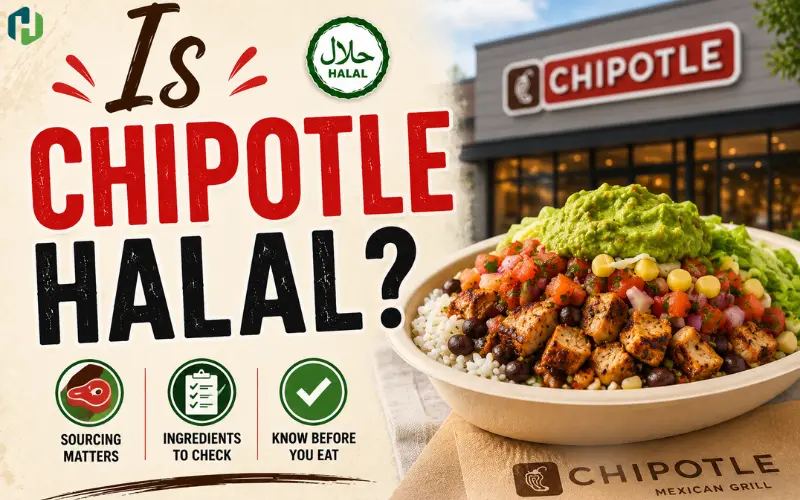
Is Chipotle halal? No. Chipotle does not have halal certification anywhere in the USA or UK, serves pork openly on its menu, and cooks all of its proteins on shared grills. If you follow a halal diet, it’s generally not a restaurant you can confidently eat at.
I remember standing in line at Chipotle with friends who couldn’t stop talking about the burrito bowls. Everything looked fresh, and at first glance the grilled chicken seemed like it could be a safe choice. But after looking into where the meat comes from and how it’s prepared, it became clear that appearances can be misleading. Fresh ingredients don’t automatically mean halal.
That’s why Chipotle is one of the most searched restaurant chains among Muslims. The question isn’t whether the food tastes good—it’s whether the meat, kitchen practices, and preparation meet halal standards. Once you understand how Chipotle operates, the answer becomes much clearer.
Quick Overview
What Is Chipotle?
Chipotle Mexican Grill is one of the largest fast-casual restaurant chains in North America. Instead of ordering a fixed meal, customers build their own burritos, bowls, tacos, salads, or quesadillas by choosing rice, beans, vegetables, sauces, cheese, and a protein.
The brand is popular because meals are prepared in front of customers using fresh ingredients. You can watch employees assemble your order from start to finish, which gives many people the impression that everything is transparent.
When it comes to halal food, though, the important question isn’t how fresh the ingredients look. It’s where those ingredients come from and how they’re handled before they reach your bowl.
Related Post: Is Subway Halal or Haram?
Is Chipotle Meat Halal?
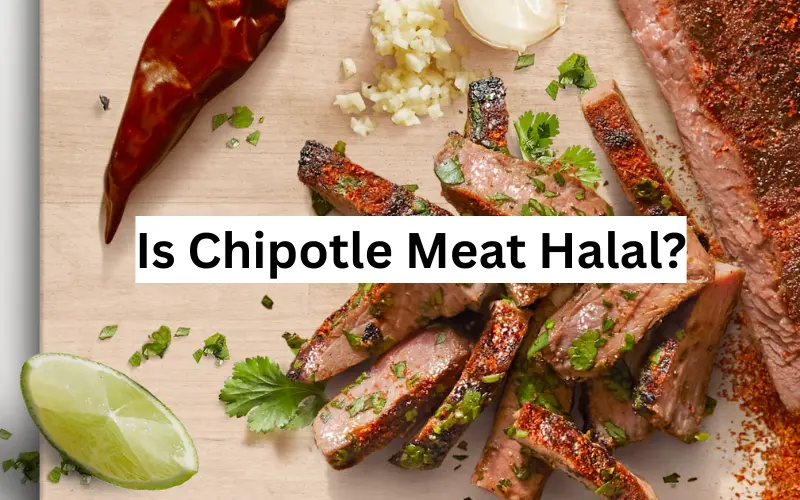
This is the biggest reason Muslims avoid Chipotle.
Chipotle does not use halal-certified meat in its restaurants. Whether you order chicken, steak, barbacoa, or brisket, the meat comes from conventional American suppliers rather than suppliers that follow halal slaughter requirements.
The company has never announced a halal meat program in the United States or the United Kingdom, and there is no third-party halal certification covering its restaurants.
That means the animals are not zabiha halal, there is no Islamic blessing at the time of slaughter, and there is no recognised halal auditing process verifying the meat from supplier to restaurant.
Chipotle’s own information about its ingredients and sourcing focuses on animal welfare, sustainability, and responsible farming. While those are positive efforts, they are completely different from halal certification. A farm can meet high welfare standards and still not produce halal meat.
This is where many people become confused.
They see phrases like responsibly raised or naturally raised and assume the meat might also be halal.
Those terms have nothing to do with halal slaughter.
For Muslims who want to eat only halal-certified meat, Chipotle’s chicken and steak don’t meet that standard. The same applies to the restaurant’s other meat options.
Because there is no halal certification and no evidence that the meat follows Islamic slaughter requirements, most Muslims consider Chipotle’s meat unsuitable for a halal diet.
Why Pork Makes the Situation Even Clearer
Even if someone chooses not to order pork, it’s impossible to ignore the fact that pork is a major part of Chipotle’s menu.
One of the restaurant’s most popular proteins is Carnitas, which is slow-cooked shredded pork.
Unlike restaurants that avoid pork altogether, Chipotle prepares and serves it throughout the day alongside its other proteins.
Islamic dietary law prohibits pork, so its presence in the kitchen immediately creates another concern beyond the meat itself. It’s no longer only about whether the chicken is halal. It’s also about how food is prepared, handled, and cooked in the same environment.
This becomes even more important once you look at how Chipotle prepares its food behind the counter.
Does Chipotle Have Halal Certification?
No.
As of today, Chipotle does not operate halal-certified restaurants in the United States or the United Kingdom.
You’ll find halal certification at many restaurant chains around the world, especially in Muslim-majority countries or at restaurants that specifically target halal-conscious customers.
Chipotle isn’t one of them.
There are no official announcements about halal-certified locations, no recognised halal logos displayed in restaurants, and no indication that the company follows a halal meat program.
I’ve seen people online claim that a particular branch is halal, but these claims usually come from misunderstandings or rumours. Unless Chipotle officially int
Is Chipotle Halal in the USA?
For Muslims living in America, the answer is straightforward.
Chipotle restaurants across the United States are not halal.
The chain serves conventional meat, openly sells pork products, and prepares food in a shared kitchen without halal separation.
Although ingredient suppliers may change over time, the company’s overall policy hasn’t changed. There is still no nationwide halal certification and no indication that its chicken or steak is sourced as zabiha halal.
If you’re specifically looking for halal Mexican food, you’re much better off choosing a certified halal Mexican restaurant instead of trying to make Chipotle work.
Related Post: Is McDonald’s Halal or Haram?
Cross-Contamination Is a Real Concern at Chipotle
Even if Chipotle suddenly started serving halal chicken tomorrow, there would still be another issue to think about.
The restaurant cooks all of its proteins on the same flat-top grill.
That includes chicken, steak, barbacoa, brisket, sofritas, and carnitas (pork). Employees don’t use a separate grill just for halal food because the restaurant doesn’t operate as a halal establishment.
So if you order a chicken bowl, your chicken was almost certainly cooked on the same cooking surface where pork was prepared earlier. The grill is cleaned throughout the day, but it isn’t treated as a halal-only cooking area.
The same applies to utensils used during cooking. Since every protein is prepared in the same kitchen, there’s no separation between halal and non-halal meat.
For many Muslims, this is just as important as the source of the meat itself. Even if someone chooses to overlook the slaughter issue, shared cooking equipment still makes Chipotle unsuitable for a strict halal diet.
Are Vegetarian Options Halal?
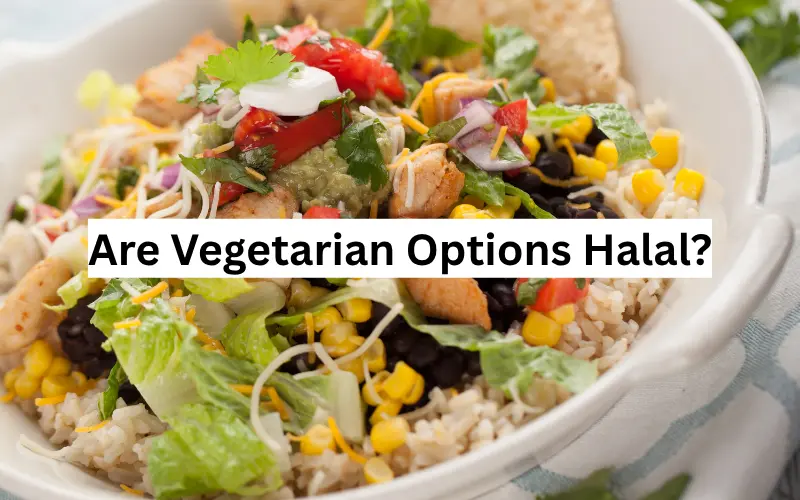
This question comes up surprisingly often.
Many people think ordering a vegetarian bowl solves the problem because there’s no meat involved.
It’s a little more complicated than that.
Ingredients like white rice, brown rice, black beans, pinto beans, fajita vegetables, lettuce, tomato salsa, corn salsa, and guacamole are generally fine on their own. None of these ingredients contain meat.
The concern begins once those ingredients are served.
Employees often use the same gloved hands throughout the serving line. Someone may scoop carnitas into one customer’s bowl and then, a few seconds later, use those same gloves while preparing a vegetarian meal.
Serving spoons can also touch different ingredients throughout a busy shift, and the preparation area isn’t designed to separate halal and non-halal orders.
Cheese is another ingredient that raises questions. Chipotle hasn’t confirmed that the rennet used in all of its cheese is halal-certified, so Muslims who avoid doubtful dairy products may choose to leave it out.
If you find yourself eating with friends or coworkers at Chipotle, a vegetarian bowl without cheese is probably the least risky meal on the menu.
That said, it still isn’t completely risk-free because of the shared kitchen and serving practices.
Dairy Products and Hidden Ingredient Concerns
People usually focus on the meat, but dairy ingredients deserve a quick mention too.
Chipotle serves shredded cheese and sour cream in many of its meals. While these products don’t contain pork, they aren’t marketed as halal-certified either.
For some Muslims, the biggest question is the source of the enzymes or rennet used during cheese production. Without halal certification, it’s difficult to know exactly how every dairy ingredient is produced.
This doesn’t automatically mean the cheese is haram, but it does add another layer of uncertainty for people trying to avoid doubtful ingredients.
When I look at Chipotle’s menu, I don’t just think about the chicken anymore. I also think about everything else that’s added to the bowl.
What Can Muslims Actually Eat at Chipotle?
Sometimes avoiding a restaurant simply isn’t practical.
You might be travelling, meeting coworkers for lunch, or joining friends who have already decided on Chipotle.
If that happens, what are the safest choices?
The safest options are the items that don’t involve meat and have the least contact with the cooking process.
Packaged drinks like bottled water, soft drinks, and fruit juice don’t create halal concerns.
Chips and salsa are also among the safest menu items because they don’t contain meat and are prepared separately from the grilled proteins.
Guacamole is another reasonable option since it’s made from avocados and fresh vegetables rather than animal ingredients.
If you want something more filling, a vegetarian bowl without cheese is probably the next best choice. Rice, beans, fajita vegetables, lettuce, salsa, and guacamole don’t contain meat themselves.
The only issue is the shared serving line. The same employees who handle pork and conventional meat also prepare vegetarian orders, so some cross-contact can happen during busy hours.
Because of that, I wouldn’t describe a vegetarian bowl as fully halal.
I’d simply describe it as the least risky meal available if you’re already at Chipotle and don’t have another restaurant nearby.
When halal-certified restaurants are available, they’re still the better choice.
Chipotle Menu Halal Risk Table
Better Halal Alternatives
Finding halal food has become much easier over the last few years, especially in larger cities across the United States and the United Kingdom.
Instead of trying to work around Chipotle’s menu, many Muslims choose restaurants that clearly advertise halal certification from the beginning.
You’ll now find halal burger restaurants, fried chicken shops, Middle Eastern grills, shawarma restaurants, kebab houses, and even halal Mexican restaurants in many cities.
The biggest advantage isn’t just the meat.
It’s the peace of mind that comes from knowing the restaurant was designed around halal requirements rather than trying to adapt a non-halal menu.
If halal food is available nearby, that’s usually the option I’d recommend over trying to figure out which Chipotle menu item carries the least risk.
We hope you guys find this guide helpful. If you like this one, here we have more for you:
- Is Gelatin Halal?
- Is KFC Halal?
- Is Dominos Pizza Halal or Haram?
- Is Chick-fil-A Halal or Haram?
- Is Dave’s Hot Chicken Halal?
Frequently Asked Questions
Is Chipotle halal in the USA?
No. Chipotle restaurants in the United States are not halal-certified. The company uses conventional meat suppliers, openly serves pork, and does not operate a halal meat program. If you only eat halal-certified meat, Chipotle isn’t considered a suitable choice.
Does Chipotle serve pork?
Yes. Chipotle serves Carnitas, which is slow-cooked shredded pork and one of its most popular protein options. Because pork is prepared and served in the same kitchen as the other menu items, many Muslims avoid eating there altogether.
Are Chipotle vegetarian options halal?
The ingredients themselves—such as rice, beans, fajita vegetables, lettuce, salsa, and guacamole—are generally suitable. The concern is how they’re served. Employees use the same gloves and serving utensils throughout the food line, and the cheese may contain rennet from an unknown source. A vegetarian bowl is the least risky meal at Chipotle, but it still isn’t completely halal because of the shared kitchen.
What is the safest thing to eat at Chipotle as a Muslim?
If you find yourself at Chipotle with friends or family, the safest choices are bottled drinks, soft drinks, water, chips and salsa, and guacamole. If you want a full meal, a vegetarian bowl without cheese is usually the best option, although it still carries some cross-contamination risk.
Does Chipotle use shared grills?
Yes. Chipotle cooks all of its proteins—including chicken, steak, barbacoa, brisket, sofritas, and pork carnitas—on the same flat-top grill. There isn’t a separate cooking area for halal food, which is one of the main reasons many Muslims avoid the restaurant.
Will Chipotle ever become halal?
It’s possible, but there’s no indication that it will happen anytime soon. Chipotle would need to switch to halal-certified meat suppliers, introduce third-party halal audits, separate halal and non-halal food preparation, and remove cross-contamination concerns. At the moment, the company has not announced any plans to introduce a halal menu.
Conclusion
So, is Chipotle halal? The answer is no. Chipotle doesn’t serve halal-certified meat, openly sells pork, and prepares all of its proteins on shared cooking surfaces, making it unsuitable for Muslims who follow a halal diet. If you’re looking for peace of mind, choosing a certified halal Mexican restaurant is a much better option than trying to work around Chipotle’s menu.