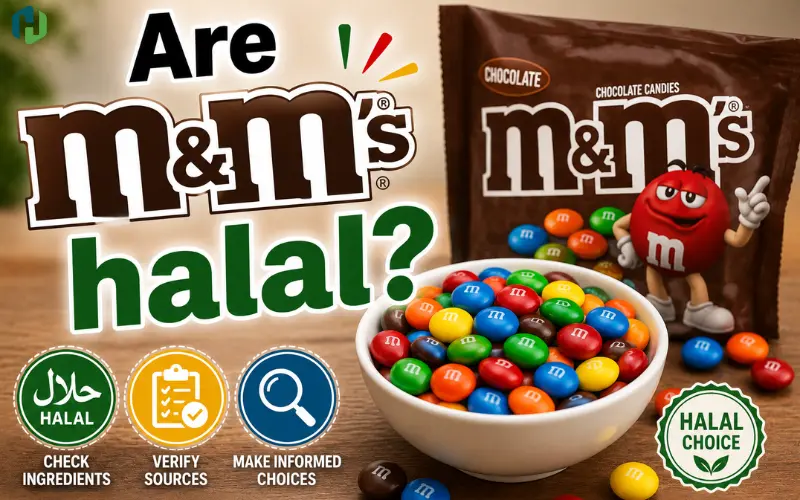
Are M&M’s halal or Haram? Many Muslims in the USA and UK search for this question because M&M’s are one of the world’s most popular chocolate candies. While the basic ingredients like chocolate, sugar, and milk are generally halal-friendly, some Muslims still question food colorings, emulsifiers, flavorings, and cross-contamination during manufacturing. Different M&M’s flavors and regional recipes can also create confusion about their halal status.
In many countries, standard milk chocolate M&M’s are generally considered halal-friendly by many Muslims because they do not contain pork gelatin or obvious haram ingredients. However, some flavors may contain doubtful additives, alcohol-based flavorings, or ingredients sourced differently depending on the country. Because recipes vary between the USA, UK, and other regions, halal-conscious consumers should always check ingredient labels and halal certification before eating M&M’s.
Quick Overview Table
| Category | Halal Status | Notes |
| Regular Milk Chocolate M&M’s | Usually Halal-Friendly | No gelatin |
| Peanut M&M’s | Usually Halal-Friendly | Check regional ingredients |
| Crispy M&M’s | Depends | Flavorings may vary |
| Limited Edition Flavors | Doubtful | Ingredients differ |
| Food Coloring | Some Concern | Scholarly differences |
| Best Option | Check Labels Carefully | Recipes vary by country |
Related Post: Halal Munchies UK Guide
What M&M’s Are Made Of

M&M’s are small chocolate candies coated in a colorful sugar shell. While they may look simple, their ingredient composition is more complex than most people expect. The core of M&M’s is chocolate, which includes sugar, cocoa solids, and milk ingredients. On top of that, there is a candy coating made from sugar and color additives.
However, what raises halal concerns are the additional ingredients used in processing. These include emulsifiers like lecithin, glazing agents, artificial and natural flavorings, and sometimes stabilizers. Each of these components can have different sources depending on the manufacturer and region.
For example, lecithin is commonly derived from soy, which is generally halal, but the processing method can still raise questions for strict consumers. Flavorings may also involve alcohol during extraction, even if it is not present in the final product in a noticeable way.
Because M&M’s are a processed snack, the ingredient list must always be examined carefully rather than relying on assumptions.
Why M&M’s Raise Halal Concerns
The halal concern with M&M’s is not based on one single ingredient but rather a combination of factors. First, processed foods often include additives that are not clearly explained. These additives can come from plant, animal, or synthetic sources, and not all of them are guaranteed to be halal.
Second, the global nature of M&M’s production means that different factories may use different ingredients. A pack produced in the UK may not be identical to one produced in the US or another country. This variation creates uncertainty because halal status cannot be generalized across all regions.
Another important factor is cross-contamination. Large manufacturing facilities often produce multiple types of products, some of which may contain non-halal ingredients. Even if M&M’s themselves do not contain haram ingredients, the shared production environment can still be a concern for strict consumers.
Because of these combined factors, M&M’s are often categorized as “depends” rather than clearly halal or haram.
Ingredients
| Ingredient | Halal Status | Notes |
| Sugar | Halal | Safe |
| Cocoa | Halal | No concern |
| Milk | Halal | Generally safe |
| Lecithin | Depends | Source matters |
| Flavoring | Depends | Check process |
| Color Additives | Usually safe | Verify |
Are Plain M&M’s Halal?

Plain M&M’s are usually considered the safest option among all varieties because they contain fewer ingredients compared to other versions. They do not include fillings like caramel or crispy layers, which reduces complexity.
For many consumers, this simplicity makes plain M&M’s a more acceptable choice. However, they still contain emulsifiers and flavorings, which means they are not automatically halal in every case. The absence of clear halal certification also means that consumers must rely on ingredient checking.
Another factor is the country of production. In some regions, plain M&M’s may be made with ingredients that align with halal standards, while in others, the same product may differ slightly. This is why checking packaging details is important.
Overall, plain M&M’s are often seen as the “better option,” but they still require verification before being considered halal.
Peanut, Crispy, and Flavored M&M’s
When it comes to peanut, crispy, and flavored M&M’s, the level of complexity increases significantly. Peanut M&M’s include roasted peanuts, which are generally halal, but the chocolate coating and processing still matter.
Crispy M&M’s include additional components such as rice or wafer layers. These ingredients introduce more processing steps and potential additives. Each added layer increases the chance of encountering non-halal ingredients or uncertain processing methods.
Flavored M&M’s, such as caramel or seasonal varieties, often contain even more additives. These may include syrups, flavor enhancers, and colorings that require careful checking.
Because of this, flavored and specialty M&M’s are usually considered less reliable compared to plain versions.
Product Comparison
| Type | Halal Status | Recommendation |
| Plain | Better | Check label |
| Peanut | Better | Verify |
| Crispy | Depends | More caution |
| Caramel | Depends | Check carefully |
| Seasonal | Depends | Avoid if unsure |
Regional Differences in M&M’s Production

One of the most important factors when assessing M&M’s halal status is the region in which they are produced. Different countries have different food regulations, ingredient sourcing, and labeling practices.
For example, M&M’s sold in the UK may have clearer ingredient labeling compared to some other regions. In some countries, manufacturers may use different emulsifiers or flavoring agents depending on availability and cost.
This means that two packs of M&M’s with the same branding may not be identical in composition. For halal-conscious consumers, this makes it essential to check the specific product rather than relying on general assumptions.
Regional differences also affect certification. In some markets, halal certification may be available, while in others it is not. This further contributes to the uncertainty.
Do M&M’s Contain Alcohol or Animal Products?
Alcohol is not typically listed as a direct ingredient in M&M’s, but it can be involved in the production of flavoring agents. During the extraction of certain flavors, alcohol may be used as a solvent. While it may not remain in the final product in significant amounts, its use still raises questions.
Animal-derived ingredients are another area of concern. While M&M’s do not usually contain gelatin, other additives such as glazing agents or emulsifiers may come from animal or plant sources.
Because these details are not always clearly stated, consumers who follow strict guidelines often prefer to avoid uncertainty.
Alcohol & Additives
| Component | Concern | Notes |
| Flavor Extracts | Possible alcohol | Trace use |
| Emulsifiers | Source unclear | Check |
| Glazing Agents | Depends | Verify |
| Additives | Mixed | Read label |
Cross-Contamination in Manufacturing
Cross-contamination is an important issue when discussing processed snacks like M&M’s. Manufacturing facilities often produce a variety of products on the same equipment. Some of these products may contain non-halal ingredients.
Because of shared production lines, there is a possibility that traces of non-halal substances may come into contact with otherwise halal ingredients. While this may not be a concern for everyone, it is important for those who follow strict halal guidelines.
This is one of the reasons why halal certification is valued. Certified products are produced under controlled conditions that minimize or eliminate cross-contamination.
Are There Halal-Certified M&M’s?

In general, M&M’s are not widely marketed as halal-certified products. This means that consumers cannot rely on certification labels and must instead check ingredients and make their own decisions.
In some regions, certain batches may meet halal standards, but this is not consistent across all markets. Because of this, many consumers prefer to choose snacks that clearly display halal certification.
Best Halal Chocolate Alternatives
If you are unsure about M&M’s, there are many alternatives available that are clearly halal-certified. These include chocolate brands that specifically cater to halal consumers.
Dark chocolate is often a simpler option because it contains fewer ingredients. Homemade snacks are another good choice, as they allow full control over ingredients.
Choosing alternatives removes uncertainty and provides peace of mind.
Alternatives
| Alternative | Benefit |
| Halal Chocolate | Certified |
| Dark Chocolate | Simpler |
| Homemade Treats | Full control |
| Halal Candy | Safer |
| Fruit Snacks | Natural |
Practical Tips for Buying Snacks
When buying snacks, always read the ingredient list carefully. Look for clear labeling and avoid products with unclear additives.
If possible, choose products that are halal-certified. This makes the decision much easier and reduces the need for detailed checking.
Consistency is also important. Once you find trusted brands, stick with them.
Common Mistakes People Make
Many people assume that all chocolate is halal, which is not always true.
Another mistake is ignoring regional differences.
The safest approach is to verify and choose trusted options.
What to Check Before Buying
Before buying M&M’s, check:
- ingredient list
- country of origin
- certification
- additives
- flavoring sources
These steps help ensure you make an informed choice.
We hope you guys find this guide helpful. If you like this one, here we have more for you:
- Is McDonald’s Halal or Haram?
- Is Kombucha Halal or Haram?
- Is Subway Halal or Haram?
- Is Rabbit Halal or Haram?
FAQs
Are regular M&M’s halal?
Many regular milk chocolate M&M’s are generally considered halal-friendly because they do not contain gelatin.
Do M&M’s contain pork gelatin?
Standard M&M’s usually do not contain pork gelatin.
Are peanut M&M’s halal?
Peanut M&M’s are generally considered halal-friendly, but ingredients may vary by country.
Why do Muslims question M&M’s?
Muslims question food colorings, flavorings, emulsifiers, and manufacturing processes.
Are UK M&M’s halal?
Some UK M&M’s products may be halal-friendly, but ingredient labels should always be checked carefully.
Do M&M’s contain alcohol?
Some specialty flavorings may contain alcohol-based ingredients depending on the product.
Are vegan M&M’s halal?
Plant-based or vegan candies are often halal-friendly if they avoid alcohol and doubtful additives.
What is the safest way to buy halal candy?
Choosing halal-certified candy brands and checking ingredient labels carefully is the safest option for Muslims.
Conclusion
Are M&M’s halal or Haram? Many standard M&M’s products are generally considered halal-friendly because they do not contain pork gelatin or obvious non-halal meat ingredients. However, halal concerns can still come from flavorings, emulsifiers, food colorings, and possible cross-contamination during manufacturing processes.
For Muslims in the USA and UK, the safest approach is checking ingredient labels and looking for halal certification when available. Since recipes and ingredients may vary by country and product flavor, halal-conscious consumers should verify each product carefully before eating.