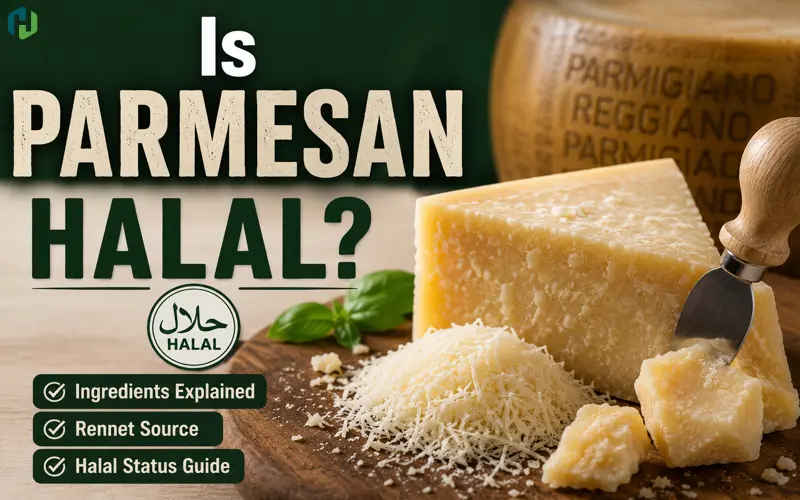
Parmesan cheese is one of the most widely used cheeses in the world. From pasta dishes and pizzas to salads and soups, its rich, savory flavor makes it a staple ingredient in countless recipes. However, many Muslims are surprised to learn that determining whether Parmesan is halal is not as straightforward as checking the ingredient label.
Traditional Parmesan is made using animal rennet, an enzyme that helps milk coagulate during cheesemaking. Whether that rennet comes from halal-slaughtered animals plays a major role in deciding if the cheese is permissible for Muslims.
Traditional Parmigiano Reggiano is usually not considered halal because it is made with animal rennet sourced from calves that are generally not slaughtered according to Islamic requirements. However, some Parmesan-style cheeses made with microbial or vegetarian rennet may be halal-friendly.
Quick Overview Table
Related Post: Is Nerds Gummy Clusters Halal?
Is Parmesan Halal?
In most cases, traditional Parmesan is not considered halal.
The issue is not the milk, salt, or aging process. Instead, the concern comes from the rennet used during production. Traditional Parmesan and authentic Parmigiano Reggiano are legally required to use animal rennet obtained from calves.
According to many Islamic scholars, animal rennet is only halal if it comes from animals slaughtered according to Islamic guidelines. Since most calves used in conventional European dairy production are not slaughtered in this way, traditional Parmesan often falls into the doubtful or non-halal category.
This is why Muslims frequently search for answers regarding parmesan cheese halal status before purchasing products containing Parmesan.
What Is Parmesan Cheese?
Parmesan refers to a hard, aged cheese known for its nutty flavor and granular texture.
Many consumers use the term Parmesan to describe all hard Italian-style cheeses, but there is an important distinction between generic Parmesan and authentic Parmigiano Reggiano.
Parmigiano Reggiano is protected under European law and can only be produced in specific regions of Italy using traditional methods.
These methods include:
- Fresh cow’s milk
- Salt
- Natural starter cultures
- Animal rennet
Because the recipe is strictly regulated, producers cannot replace animal rennet with vegetarian alternatives and still call the cheese Parmigiano Reggiano.
This legal requirement is one of the biggest reasons why questions about Parmigiano Reggiano halal status continue to arise.
Why Is Parmesan Not Halal?
One of the most searched questions online is: Why is Parmesan not halal?
The answer revolves around rennet.
Rennet is an enzyme complex used to separate milk into curds and whey during cheesemaking. Traditionally, rennet is extracted from the stomach lining of young calves.
For Muslims, the source of that animal matters.
If the calf was not slaughtered according to Islamic requirements, many scholars consider the resulting rennet impermissible. Since authentic Parmesan uses calf rennet from conventional dairy production, the cheese often fails to meet halal standards.
The cheese itself may contain no pork, no alcohol, and no obvious haram ingredients. Yet the production method creates the halal concern.
This is why many Muslims avoid traditional Parmesan despite its otherwise simple ingredient list.
Ingredient Analysis Table
Animal Rennet
Many consumers assume cheese is automatically halal because it contains dairy ingredients.
However, rennet changes the discussion entirely.
Animal rennet is typically obtained from the fourth stomach chamber of young calves. Cheesemakers value it because it produces specific textures and flavors that are difficult to replicate.
For centuries, Italian cheesemakers have relied on animal rennet to create Parmigiano Reggiano.
While some scholars hold more lenient views regarding rennet transformation during cheesemaking, many halal certification organizations require that the source animal itself be halal-slaughtered.
Because producers rarely provide detailed slaughter information, traditional Parmesan remains problematic for many Muslims.
Is Parmigiano Reggiano Halal?
Authentic Parmigiano Reggiano is generally not considered halal by most halal certification bodies.
The cheese consortium that oversees Parmigiano Reggiano production requires the use of traditional calf rennet.
Since producers cannot substitute microbial or vegetarian rennet and still maintain protected status, halal certification is extremely difficult to obtain.
This means that even though Parmigiano Reggiano contains only a few ingredients, its production process prevents many Muslims from considering it halal.
Consumers searching for Parmigiano Reggiano halal options often discover that certified alternatives are extremely rare.
Parmesan vs Parmigiano Reggiano
Many shoppers do not realize there is a difference between Parmesan and Parmigiano Reggiano.
Comparison Table
This distinction is important because generic Parmesan may sometimes use microbial or vegetarian rennet, making it a better option for Muslims.
Is Parmesan Cheese Halal in the USA?
In the United States, the answer depends heavily on the manufacturer.
Some American Parmesan brands use microbial enzymes instead of traditional calf rennet. Others continue to use animal-derived enzymes without providing detailed sourcing information.
The challenge for Muslim consumers is that ingredient labels often simply list “enzymes” rather than specifying their origin.
As a result, two Parmesan products sitting next to each other on a supermarket shelf may have completely different halal statuses.
When shopping in the United States, consumers should look for:
- Halal certification
- Vegetarian certification
- Microbial enzymes
- Explicit rennet disclosures
Without this information, determining whether a specific Parmesan cheese is halal can be difficult.
Is Parmesan Cheese Halal in the UK?
The situation in the United Kingdom is similar.
British supermarkets sell both imported Parmigiano Reggiano and locally produced Parmesan-style cheeses.
Many imported Italian products use traditional animal rennet, making them unsuitable for Muslims who require strict halal compliance.
However, several UK brands produce hard Italian-style cheeses using vegetarian enzymes.
For this reason, Muslims in London, Birmingham, Manchester, and other cities often rely on ingredient verification rather than simply checking the product name.
The term Parmesan alone does not guarantee halal status.
Does Parmesan Contain Pork?
Technically, Parmesan does not usually contain pork.
The halal concern comes from calf-derived rennet rather than pork ingredients.
Most traditional Parmesan cheeses contain:
- Milk
- Salt
- Starter cultures
- Calf rennet
Because pork is generally absent, some consumers mistakenly assume the cheese must be halal.
Islamic dietary rules, however, extend beyond pork and require examination of all animal-derived ingredients.
Therefore, the absence of pork does not automatically make Parmesan permissible.
Is Vegetarian Parmesan Halal?
Vegetarian Parmesan is often the best option for Muslim consumers.
Instead of animal rennet, these products use:
- Microbial rennet
- Fermentation-produced enzymes
- Plant-based coagulating agents
Because no animal slaughter is involved, many halal scholars consider these alternatives permissible.
However, consumers should still review ingredient labels and look for halal certification whenever possible.
Not every vegetarian product automatically qualifies as halal, but vegetarian Parmesan generally presents fewer concerns than traditional versions.
Country Comparison
How We Evaluated Parmesan
Our assessment is based on multiple factors that influence halal status.
Evaluation Table
Common Foods That May Contain Parmesan
Many Muslims unknowingly consume Parmesan through prepared foods.
Products that frequently contain Parmesan include:
- Caesar salads
- Pasta sauces
- Garlic bread toppings
- Frozen pizzas
- Crackers
- Snack foods
- Restaurant pasta dishes
Even when Parmesan appears in small amounts, the rennet concern remains the same.
Checking ingredient labels becomes especially important when buying processed foods.
Best Halal Alternatives to Parmesan
Fortunately, several alternatives offer a similar flavor profile without the halal concerns.
Alternative Brands
These products provide a practical solution for Muslims who want Parmesan flavor while maintaining halal compliance.
We hope you guys find this guide helpful. If you like this one, here we have more for you:
- Are Twizzlers Halal or Haram?
- Is Greggs Halal or Haram?
- Is Lindt Chocolate Halal?
- Is Cadbury Dairy Milk Halal or Haram?
- Is Shake Shack Halal or Haram?
FAQs
Is Parmesan halal or haram?
Traditional Parmesan is usually considered non-halal because it contains animal rennet from conventionally slaughtered calves.
Why is Parmesan not halal?
The primary concern is calf-derived animal rennet rather than the milk itself.
Is Parmigiano Reggiano halal?
Authentic Parmigiano Reggiano is generally not considered halal because traditional production requires animal rennet.
Does Parmesan contain pork?
Typically no. The concern is calf rennet rather than pork ingredients.
Can Muslims eat Parmesan cheese?
It depends on the rennet source. Traditional Parmesan is often avoided, while vegetarian Parmesan may be acceptable.
Is vegetarian Parmesan halal?
In many cases, yes, especially when microbial or plant-based enzymes are used.
Is Parmesan cheese halal in the USA?
Some brands may be halal-friendly, but traditional versions often are not.
Is Parmesan cheese halal in the UK?
The answer varies by manufacturer and rennet source.
Final Thought
After examining traditional production methods, ingredient sources, and halal certification standards, the conclusion is clear.
Traditional Parmesan and authentic Parmigiano Reggiano are generally not considered halal because they use animal rennet derived from calves that are typically not slaughtered according to Islamic requirements.
However, not every Parmesan-style cheese falls into this category. Many modern manufacturers now produce vegetarian or microbial-rennet alternatives that may be suitable for Muslims.