
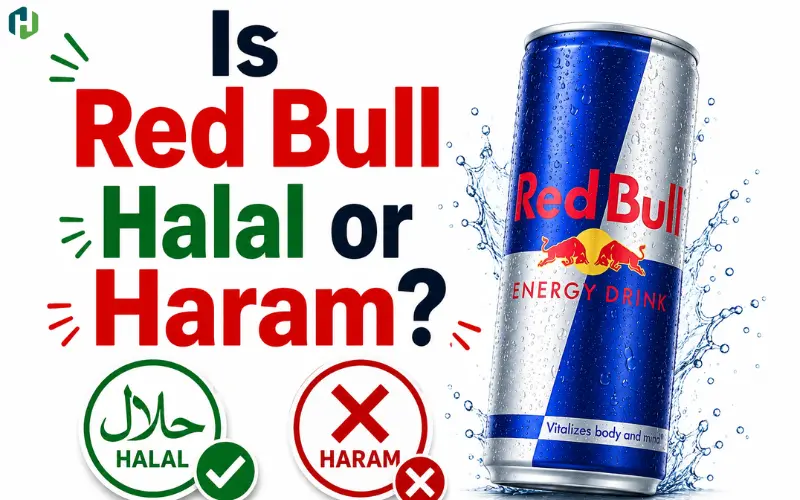
Is Red Bull Halal or Haram? Yes, Red Bull is generally considered halal. It has no pork, no alcohol, and the taurine inside is 100% synthetic — not from animals. In countries like Malaysia, and South Africa it carries official halal certification. In the USA and UK there’s no official halal stamp on the can, but the ingredients themselves are clean. Most scholars say it’s permissible.
Quick Answer
Okay so Red Bull is one of those things where the rumour spread way faster than the actual facts. I can’t tell you how many times I’ve heard “bhai Red Bull mein bull ka khoon hota hai” or something equally dramatic. People genuinely believe this drink is made from a bull. It is not. The name comes from a Thai drink called Krating Daeng. That’s it. No bull involved.
But jokes aside, the real questions Muslims have about Red Bull are actually fair ones — taurine, alcohol in flavouring, no halal stamp on the can. These deserve a proper answer, not just “bro it’s fine trust me.”
So let’s go through it properly.
Related Post: Is Prime Drink Halal or Haram?
The taurine thing — let’s kill this myth once and for all
Taurine is the ingredient that causes the most worry. The word itself comes from the Latin “taurus” meaning bull, because back in 1827 scientists first isolated it from ox bile. That history is real. And that history is also completely irrelevant to what’s in your Red Bull can today.
Modern commercial taurine — the kind every major energy drink uses including Red Bull — is made in a laboratory through chemical synthesis. It has been made this way since the 1990s. No animal is involved. No bull bile. No slaughter. Nothing.
Red Bull’s own customer service has confirmed this in writing: the taurine in their products is produced synthetically by pharmaceutical companies and is not derived from animals. Multiple halal certification bodies around the world have verified this same fact when certifying Red Bull in their respective markets.
So when someone tells you Red Bull has bull bile in it, you can confidently tell them that’s not how it works anymore. The name is old. The production method is modern.
What’s actually in a can of Red Bull?
Here’s the full ingredient breakdown with a honest halal assessment for each one.
The only one that raises any eyebrow is natural flavours, and we’ll talk about that in a moment.
Does Red Bull have alcohol in it?
No. Not in the way people worry about.
Red Bull does not contain added alcohol. It is a non-alcoholic drink. You will not find ethanol listed anywhere in the ingredients because it genuinely isn’t there.
The only connection to alcohol is the same one that comes up with vanilla extract, natural flavours, and dozens of common food ingredients — some flavouring compounds are extracted using alcohol as a solvent during manufacturing. But the alcohol itself doesn’t end up in the final product in any meaningful quantity. We’re talking traces so small they’re basically undetectable.
Major halal bodies like IFANCA in North America, MUI in Indonesia, JAKIM in Malaysia, and the Muslim Judicial Council in South Africa have all certified Red Bull as halal, and they are well aware of how flavouring works. They didn’t just take Red Bull’s word for it — they audited the supply chain. And they still gave the certification.
The scholarly principle that applies here is called istihlak — the idea that when a prohibited substance is so completely dissolved and undetectable in a product that it cannot cause any harm or intoxication, it loses its haram status. This is the same ruling that allows Muslims to eat bread made with yeast fermentation or drink natural vinegar.
So why doesn’t Red Bull USA have a halal label on the can?
This is honestly where a lot of the confusion comes from. You pick up a Red Bull in the US, you look for a halal stamp, you don’t see one. And your brain goes “something must be wrong.”
Here’s what’s actually happening. Getting halal certified in every country requires going through each country’s certification body separately, paying the fees, going through the audit process, and maintaining it ongoing. Companies do this where there’s enough Muslim consumer demand to make it worth the cost. In countries with large Muslim populations like, Indonesia, South Africa — Red Bull has done exactly that.
In the US, the Muslim population is smaller relative to the total consumer base. Red Bull hasn’t pursued IFANCA certification for the American market specifically. But here’s the important part: the formula is identical. The same ingredients, the same production standards, the same synthetic taurine, the same no-alcohol policy. The can looks different, the label is in English, but what’s inside is the same drink.
No halal stamp doesn’t mean haram ingredients. It means the company didn’t go through the certification paperwork in that market. Those are two completely different things.
What about Red Bull in the UK?
Same situation. No official halal certification on UK cans. And the same logic applies — the formula is the same as certified markets. However, a stricter site called HalalCodeCheck classifies UK Red Bull as “Mushbooh” specifically because the natural flavours listed on the label have an undisclosed source. They’re not saying it’s haram — they’re saying it’s unclear because Red Bull UK hasn’t disclosed where those natural flavours come from.
That’s a fair and honest concern actually. “Natural flavours” can technically come from plant or animal sources, and UK labelling law doesn’t require companies to specify which. Red Bull hasn’t published that information for their UK formulation.
So for the UK specifically, if you follow the strict position, the Mushbooh label makes sense. If you go by the majority scholarly position — that the ingredients are likely fine and the certification in other markets confirms that — then you’d still consider it permissible.
Is Red Bull halal in the USA specifically?
No official certification exists for the US market. But the ingredients are the same as the certified versions sold elsewhere. Most American Muslim scholars and Islamic centers would consider it permissible based on ingredient analysis.
If you want to be extra careful, look for Red Bull imported from or sold in Muslim-majority markets where it carries official certification — some halal grocery stores do stock these. Otherwise, the majority position from scholars is that the standard US Red Bull is permissible to drink.
What about Red Bull Sugar Free and the flavoured editions?
Red Bull Sugar Free (the blue can) uses artificial sweeteners instead of sugar — aspartame and acesulfame K. Both are synthetically produced and halal.
The flavoured editions (Red, Yellow, Blue, Purple cans etc.) are where you should be slightly more careful. Some of these contain additional food colourings that may vary by region. The natural and artificial flavours in these editions also vary, and the same “undisclosed source” concern applies. They’re not confirmed haram, but there’s less transparency compared to the classic silver can.
If you want the safest Red Bull option, the original classic can is the most straightforward one.
Can you drink Red Bull during Ramadan?
If you’re talking about drinking it while fasting — no, obviously not. You can’t eat or drink anything during fasting hours, halal or not.
But during non-fasting hours — after iftar, before suhoor — yes, Red Bull is permissible to drink the same way any other halal beverage would be. Some people like it for that late-night energy during Ramadan nights. As long as it’s within your eating window, there’s no issue.
One thing worth mentioning though: Red Bull contains a decent amount of caffeine and sugar. Drinking it on an empty stomach right at iftar isn’t the greatest idea health-wise. Halal doesn’t automatically mean healthy. Eat proper food first.
What do scholars actually say?
The official rulings from credible Islamic bodies are consistent on this:
IFANCA (Islamic Food and Nutrition Council of America) has certified Red Bull in multiple markets. MUI Indonesia, JAKIM Malaysia, and the Muslim Judicial Council of South Africa have all issued halal certification for Red Bull. Multiple muftis who have been asked about it have responded that it is permissible based on the synthetic taurine and absence of alcohol.
The minority stricter view comes from scholars who want full ingredient transparency on natural flavours before issuing a ruling. Their caution is legitimate, just not the majority position.
If you like this one, here we have more for you:
- Is Non Alcoholic Wine Halal or Haram?
- Is Alani Nu Halal or Haram?
- Is Haribo Halal or Haram?
- Is Poppi Halal or Haram?
- Is CAVA halal or Haram?
- Is Lindt Chocolate Halal?
Frequently Asked Questions
Is Red Bull haram in Islam?
No. Red Bull contains no pork, no alcohol, and no animal-derived ingredients. Most Islamic scholars and halal certification bodies consider it halal.
Is taurine in Red Bull from a bull?
No. The taurine in Red Bull is synthetically made in a laboratory. Red Bull has confirmed this officially. It has nothing to do with actual bulls or bull bile.
Is Red Bull halal in the USA?
Red Bull USA does not carry official halal certification, but the ingredients are the same as certified versions sold elsewhere. Most scholars consider it permissible based on its ingredient list.
Is Red Bull halal in the UK?
No official halal certification for UK Red Bull exists. Some scholars classify it as Mushbooh due to undisclosed natural flavours. The majority position is still permissible.
Can Muslims drink Red Bull during Ramadan?
During fasting hours, no — nothing can be consumed. During non-fasting hours (after iftar, before suhoor), yes, it is permissible to drink.
Is Red Bull Sugar Free halal?
Yes. The sugar free version uses synthetic sweeteners and has the same halal status as the original. Check the classic silver or blue can over the flavoured editions for the most straightforward option.
Conclusion
Red Bull is not haram. The bull bile myth is just that — a myth. The taurine is synthetic, there’s no alcohol in it, no pork, no gelatin. In countries with large Muslim populations it carries official halal certification from respected Islamic bodies. In the USA and UK there’s no certificate on the can, but the formula is the same and most scholars consider it permissible.
If you’re the kind of person who only drinks officially certified products, look for Red Bull from certified markets or pick a different certified energy drink. If you go by ingredients and majority scholarly opinion, the standard can is fine.
The only ongoing grey area is the undisclosed natural flavours, specifically in UK and US versions. That’s a real concern worth knowing about, even if most Muslims still consider it permissible.
Drink it, don’t stress about it. Just maybe don’t have three cans in a row — that’s a health problem, not a halal one.