
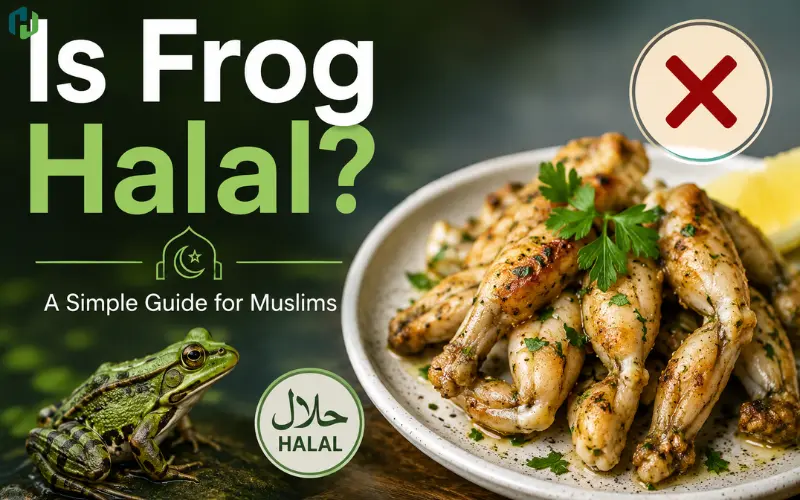
You’re at a restaurant, browsing the menu, and suddenly you spot frog legs. They might be listed as a local specialty, and people around you seem to enjoy them. That raises a simple question:
Can Muslims eat frogs, or are they considered haram?
The short answer is no. Most Islamic scholars agree that frogs are not halal, which means Muslims should avoid eating them. The confusion usually comes from the fact that frogs spend much of their lives in water, leading some people to assume they fall under the same category as fish. However, that’s not how the majority of scholars view them.
In this guide, we will break everything down, explain why frogs are treated differently, and help you make an informed decision the next time you come across frog meat.
Quick Answer
Why Do People Ask If Frogs Are Halal?
It’s actually a fair question.
Unlike chicken or beef, frogs aren’t something most Muslims eat regularly. But if you’ve traveled abroad or watched cooking shows, you’ve probably seen frog legs served as a delicacy. They’re especially common in some European and Asian cuisines, which naturally makes Muslims wonder whether they’re permissible.
Another reason for the confusion is that frogs spend part of their lives in water. Many people assume that anything connected to water is automatically halal, but that’s not always the case. Frogs are amphibians, and they’re treated differently from fish when discussing halal foods.
Related Post: Is Alligator Halal or Haram?
So, Is Frog Halal?
For everyday Muslims looking for a clear answer, the safest response is no.
The majority of Islamic scholars do not consider frogs halal to eat. This has been the widely accepted opinion for many years and is also reflected in the guidance provided by many halal organizations.
While you may come across different opinions online, they represent a much smaller view. If your goal is to stay within the most widely accepted halal guidelines, avoiding frog meat is the recommended choice.
For most people, that removes any doubt and makes food choices much easier.
Why Frogs Are Treated Differently from Fish
This is where many people get confused.
At first glance, frogs and fish seem similar because both are closely connected to water. But biologically, they’re very different animals.
Fish spend their entire lives in water. Frogs don’t. They begin life in water as tadpoles, then develop lungs and live both on land and in water. Because of that, scholars generally don’t place frogs in the same category as fish when discussing halal foods.
That’s why someone might happily order grilled fish but avoid frog legs, even if both appear on the same menu.
Frog vs Fish Comparison
What About Frog Legs?
One of the most searched questions online is whether frog legs have a different ruling from the rest of the animal.
The answer is simple—they don’t.
Frog legs are just the edible part of the frog. Whether they’re fried, grilled, baked, or served with garlic butter, the cooking style doesn’t change the halal ruling.
So if you see frog legs on a menu while traveling or dining at an international restaurant, it’s generally better to choose another dish that’s clearly halal.
Better Halal Alternatives to Frog Meat
If you’re curious about trying something different, the good news is that there are plenty of halal options that don’t come with the same uncertainty.
Chicken is one of the easiest alternatives because it’s widely available and works well in almost any recipe. If you enjoy seafood, fish and shrimp are also excellent choices when sourced from halal-friendly suppliers. Halal-certified beef, lamb, and turkey offer even more variety for everyday meals.
Choosing foods that are clearly halal gives you peace of mind and removes the need to second-guess your meal.
Alternative Meat Options
Common Myths About Frog Meat
Because frog meat isn’t something most Muslims eat regularly, a lot of misinformation has spread online. Here are some of the most common myths.
Myth 1: Frogs Are Halal Because They Live in Water
This is the biggest misconception. While frogs spend part of their lives in water, they’re amphibians—not fish. That’s why they’re generally treated differently when discussing halal foods.
Myth 2: Frog Legs Have a Different Ruling
Some people believe only the legs are eaten, so they might be treated differently.
In reality, frog legs are simply the meat of the frog. The part of the animal doesn’t change its halal status.
Myth 3: Cooking Makes Frog Meat Halal
Whether it’s grilled, fried, roasted, or baked, the cooking method doesn’t change the ruling.
Myth 4: If It’s Served in a Restaurant, It Must Be Halal
Many international restaurants serve foods that aren’t halal. Seeing frog legs on a menu doesn’t mean they’re permissible for Muslims.
If you like this one, here we have more for you:
- Is Catfish Halal or Haram?
- Is Crab Halal or Haram?
- Lobster Halal or Haram?
- Is Shrimp Halal or Haram?
- Is Octopus Halal or Haram?
Frequently Asked Questions
Are frogs halal?
According to the majority scholarly opinion, no. Frogs are generally considered non-halal and Muslims are advised to avoid eating them.
Are frog legs halal?
No. Frog legs come from the frog itself, so they carry the same ruling.
Why do people think frogs are halal?
The confusion usually comes from the fact that frogs live in water. Many people assume they’re similar to fish, but scholars generally make a clear distinction between the two.
Does the country of origin matter?
No. Whether a frog comes from Asia, Europe, America, or anywhere else, its halal status doesn’t change.
Can frog meat become halal if it’s cooked in a halal restaurant?
No. The restaurant or cooking method doesn’t change the halal status of the meat itself.
Conclusion
So, is frog halal?
For most Muslims, the answer is no.
The majority scholarly opinion considers frogs non-halal, which means both frog meat and frog legs should generally be avoided. Although frogs are closely associated with water, they aren’t treated the same way as fish under Islamic dietary guidelines.
If you’re ever unsure about a food, choosing a clearly halal alternative is usually the best decision. Fortunately, there are plenty of delicious options—from chicken and beef to fish and lamb—that let you enjoy your meal without any uncertainty.
When it comes to halal eating, peace of mind is just as important as the food on your plate.