
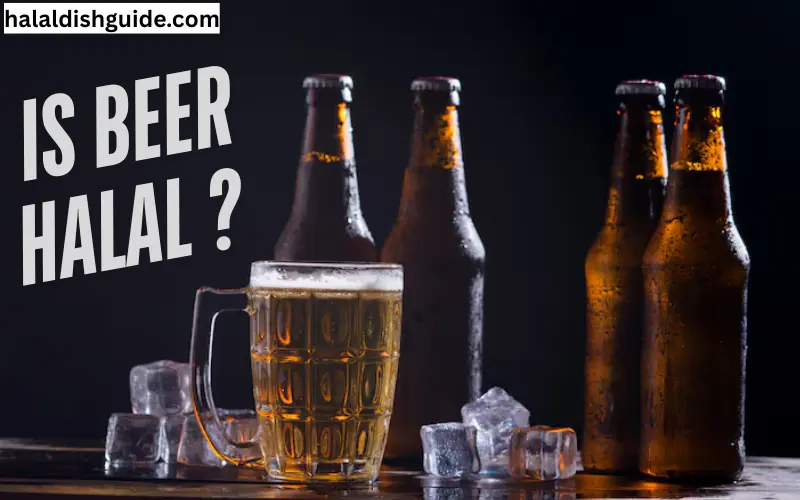
Is beer halal? No. Traditional beer is not halal because it contains alcohol produced through fermentation. Whether it’s a light beer, lager, ale, stout, or craft beer, the presence of intoxicating alcohol means Muslims should avoid drinking it.
I’ll admit that this question surprised me the first time someone asked it. I thought everyone knew the answer. Then I realized why so many people search for it. Supermarkets are now full of products labeled light beer, alcohol-free beer, 0.0% beer, and even root beer. Some contain alcohol, some don’t, and their names alone are enough to confuse people.
That’s why it’s important to look beyond the word “beer.” Some drinks only borrow the name, while others are made through the same brewing process as regular beer. Once you understand how they’re produced, the answer becomes much easier to understand.
Quick Overview
Why This Question Isn’t as Simple as It Looks
Years ago, the answer would have taken only one sentence.
Beer contains alcohol, so Muslims avoid it.
Today, things are a little more complicated.
Walk through any supermarket in the USA or UK and you’ll find shelves filled with products that seem similar but aren’t actually the same. You’ll see regular beer, non-alcoholic beer, alcohol-free beer, zero alcohol beer, ginger beer, root beer, and dozens of flavored malt drinks.
Some contain enough alcohol to intoxicate.
Others contain tiny traces left over from the brewing process.
Some don’t contain alcohol at all despite having the word beer on the label.
This is why so many Muslims ask whether every drink with the word “beer” automatically has the same ruling.
The answer depends on what’s inside the bottle—not what’s printed on the front.
Related Post: Is Red Bull Halal or Haram?
What Is Beer Made From?
Traditional beer is made from four basic ingredients — water, malted barley or other grains, hops, and yeast. None of these raise any concern on their own. The problem starts during fermentation, when yeast feeds on the natural sugars in the grain and converts them into alcohol and carbon dioxide. That alcohol isn’t added afterward — it’s created as a direct result of the brewing process itself.
Different styles of beer contain different amounts of alcohol.
A light lager may contain around 4% alcohol, while some craft beers exceed 8% or even 10%.
Regardless of the percentage, they’re all produced using the same basic fermentation process.
Why Beer Is Considered Haram
For Muslims, the main issue isn’t the brand, the country where it’s was brewed, or how expensive it is.
The issue is alcohol.
Beer is made specifically to produce an intoxicating drink.
Whether someone drinks one bottle or several, the product itself belongs to the category of alcoholic beverages.
Sometimes people ask whether a very weak beer is different from a strong beer.
From a halal perspective, changing the alcohol percentage doesn’t change the purpose of the drink.
A beer containing 4% alcohol and another containing 8% alcohol are both alcoholic drinks.
The difference is only how much alcohol they contain—not whether they’re alcoholic in the first place.
This is why you’ll find that Muslim consumers generally avoid beer regardless of whether it’s described as premium, craft, imported, or locally brewed.
Does the Alcohol Percentage Matter?
One of the biggest misunderstandings is that a lower alcohol percentage somehow makes beer acceptable.
It doesn’t work that way.
Imagine two bottles sitting next to each other.
One contains 4% alcohol.
The other contains 8%.
Neither becomes halal simply because one contains less alcohol than the other.
The brewing process is still designed to create an alcoholic beverage.
That’s why you’ll often hear people say things like:
“It’s only a little alcohol.”
The amount may be smaller, but the nature of the drink hasn’t changed.
This question becomes even more interesting when we start looking at products labeled 0.0% alcohol or alcohol-free beer, because those drinks aren’t always produced in the same way as traditional beer.
Is One Sip of Beer Allowed?
This is another question people ask surprisingly often.
Some wonder whether taking just one sip makes any difference.
Others think tasting someone else’s drink without becoming intoxicated might be acceptable.
The issue isn’t whether one sip causes drunkenness.
The issue is that beer is still an alcoholic beverage.
Whether someone drinks a small amount or a large amount doesn’t change what the drink actually is.
That’s why Muslims who follow halal dietary guidelines generally avoid beer altogether rather than trying to judge how much would or wouldn’t have an effect.
For most people, the simplest approach is also the clearest one.
If it’s beer containing alcohol, leave it on the shelf.
Alcohol-Free Beer vs Non-Alcoholic Beer
This is where many people get confused.
The words “alcohol-free” and “non-alcoholic” sound like they mean exactly the same thing, but food labeling laws don’t always treat them that way.
In many countries, non-alcoholic beer can still contain a very small amount of alcohol. Depending on local regulations, it may contain up to 0.5% alcohol by volume (ABV) and still legally be sold as non-alcoholic.
Alcohol-free beer, on the other hand, is usually marketed as containing 0.0% alcohol. Even then, it’s worth reading the label because standards vary between manufacturers and countries.
Another point many Muslims overlook is how these drinks are made.
A large number of alcohol-free and non-alcoholic beers begin life exactly like regular beer. They’re brewed through fermentation, and the alcohol is removed later using different processing methods.
Some Muslims are comfortable drinking products that genuinely contain 0.0% alcohol.
Others avoid them because they imitate beer or are produced using the same brewing process as alcoholic drinks.
That’s why you’ll hear different opinions within the Muslim community.
If you’re unsure, choosing an ordinary soft drink, juice, or sparkling water removes the uncertainty altogether.
Related Post: Is Alani Nu Halal or Haram?
Can Muslims Drink 0.0% Beer?
This has become one of the biggest halal questions in recent years.
Walk into a supermarket today and you’ll find brands advertising 0.0% beer, often placed right beside regular beer.
Brands like Heineken 0.0, Beck’s Blue, Erdinger Alkoholfrei, and Athletic Brewing have become genuinely mainstream. You’ll find them in most major supermarkets across the USA and UK, often marketed as healthier alternatives to regular beer. The reason Muslims need to look more carefully at these is that most of them—including Heineken 0.0 and Beck’s Blue—are still brewed exactly like regular beer first, and then the alcohol is removed afterward through a process called dealcoholization. So even though the final product contains no measurable alcohol, it started its life as an alcoholic drink. That’s exactly why scholars who take the stricter position say to avoid them—not because of what’s in the bottle now, but because of how it got there.
What About Root Beer?
Despite its name, root beer usually isn’t beer at all.
This surprises many people.
Traditional root beer is a soft drink made from flavorings, spices, herbs, vanilla, and sweeteners. Modern commercial root beer is normally carbonated just like cola or lemonade.
It isn’t brewed like regular beer, and it doesn’t normally contain alcohol.
The word “beer” is mostly historical.
Because of the name, many Muslims avoid it without checking the ingredients. In reality, popular root beer brands sold in supermarkets are generally alcohol-free soft drinks.
Still, it’s always worth reading the label because recipes can vary between manufacturers, especially if you’re buying traditional craft versions.
If the ingredients show no alcohol and the drink isn’t produced as an alcoholic beverage, root beer is generally treated differently from regular beer.
Is Cooking With Beer Allowed?
Some people believe cooking completely solves the problem because the alcohol “burns off.”
The reality isn’t quite that simple.
When beer is added to sauces, stews, or marinades, some alcohol may evaporate during cooking. However, studies have shown that not all alcohol disappears, especially if the cooking time is short.
Even after long cooking times, small amounts can still remain.
There’s another point many Muslims think about.
Beer wasn’t created as a cooking ingredient. It’s an alcoholic drink that’s being added to food.
For that reason, many Muslims prefer avoiding recipes that call for beer altogether.
Fortunately, it’s easy to replace beer in cooking.
Beef broth, chicken stock, vegetable stock, apple juice, ginger ale, or alcohol-free cooking liquids can often produce similar results without raising halal concerns.
If I’m following a recipe that includes beer, I simply swap it for another liquid instead of wondering how much alcohol might still be left.
Common Misunderstandings About Beer
One misunderstanding is that light beer must somehow be different because it contains less alcohol.
It isn’t. It’s still brewed as an alcoholic drink.
Another common myth is that expensive imported beer might be different from ordinary beer.
Price doesn’t change how it’s produced.
People also assume that every drink with the word “beer” contains alcohol.
That’s not true.
Root beer is a good example of a drink that usually contains no alcohol despite its name.
Finally, many shoppers believe that non-alcoholic always means zero alcohol.
Depending on local food regulations, that isn’t always the case.
That’s why reading the label carefully is much more useful than relying on the name printed on the bottle.
Beer Types & Halal Status
Beer Types & Halal Status
Not every drink with the word beer belongs in the same category, which is why reading the label is so important.
Traditional beers such as lagers, ales, stouts, pilsners, wheat beers, and craft beers are all brewed to produce alcohol. Whether they’re made in the USA, UK, Germany, or anywhere else, they aren’t considered halal because they’re alcoholic beverages.
Root beer is different. Despite its name, it’s usually just a carbonated soft drink and doesn’t contain alcohol. That’s why it shouldn’t automatically be grouped together with traditional beer.
Non-alcoholic beer and alcohol-free beer require a little more attention. Some products genuinely contain 0.0% alcohol, while others may contain a small amount that still falls within local labeling laws. Checking the bottle is always better than relying on the product name alone.
What Should Muslims Drink Instead?
Giving up beer doesn’t mean giving up choice.
Today, supermarkets and restaurants offer plenty of refreshing drinks that don’t create the same halal concerns.
Sparkling water is one of the simplest alternatives, especially if you enjoy fizzy drinks. Fruit juices, lemonade, iced tea, and flavored mineral water are also easy options that are widely available in both the USA and UK.
Many Muslims also enjoy traditional drinks such as fresh mint lemonade, mango juice, lassi, falooda, or rose milk, depending on what’s available locally.
If you’re at a restaurant where others are ordering beer, choosing one of these drinks usually removes any uncertainty and lets you enjoy the meal without worrying about what’s in your glass.
Halal Drink Alternatives
We hope you guys find this guide helpful. If you like this one, here we have more for you
- Is Monster Halal?
- Is Poppi Halal or Haram?
- Is White Wine Vinegar Halal or Haram?
- Is CAVA halal or Haram?
- Is Prime Drink Halal or Haram?
Frequently Asked Questions
Is beer halal?
No. Traditional beer contains alcohol produced through fermentation, so it isn’t considered halal.
Is non-alcoholic beer halal?
It depends on the product. Some non-alcoholic beers may still contain small amounts of alcohol, while others are completely alcohol-free. Many Muslims still choose to avoid them because they’re made to imitate beer.
Can Muslims drink 0.0% beer?
Some Muslims consider genuine 0.0% beer acceptable if it contains no alcohol at all, while others avoid it because it’s brewed and marketed as a beer. If you’re unsure, choosing another soft drink is the simpler option.
Is root beer halal?
In most cases, yes. Root beer is usually a soft drink and doesn’t contain alcohol. Even so, it’s always a good idea to check the ingredients because recipes can vary.
Is cooking with beer halal?
Most Muslims avoid cooking with beer. Although some alcohol may evaporate during cooking, not all of it necessarily disappears, and there are plenty of halal alternatives that work just as well.
Does the alcohol percentage matter?
No. Whether a beer contains 4%, 6%, or 8% alcohol doesn’t change the fact that it’s an alcoholic beverage. A lower percentage doesn’t make traditional beer halal.
Conclusion
So, is beer halal? For traditional beer, the answer is no because it’s brewed to produce alcohol. Drinks such as 0.0% beer, non-alcoholic beer, and root beer should be judged individually rather than by their names alone. When there’s any doubt, choosing a drink that clearly contains no alcohol is the easiest and safest option.